The best driveway alarms in the UK

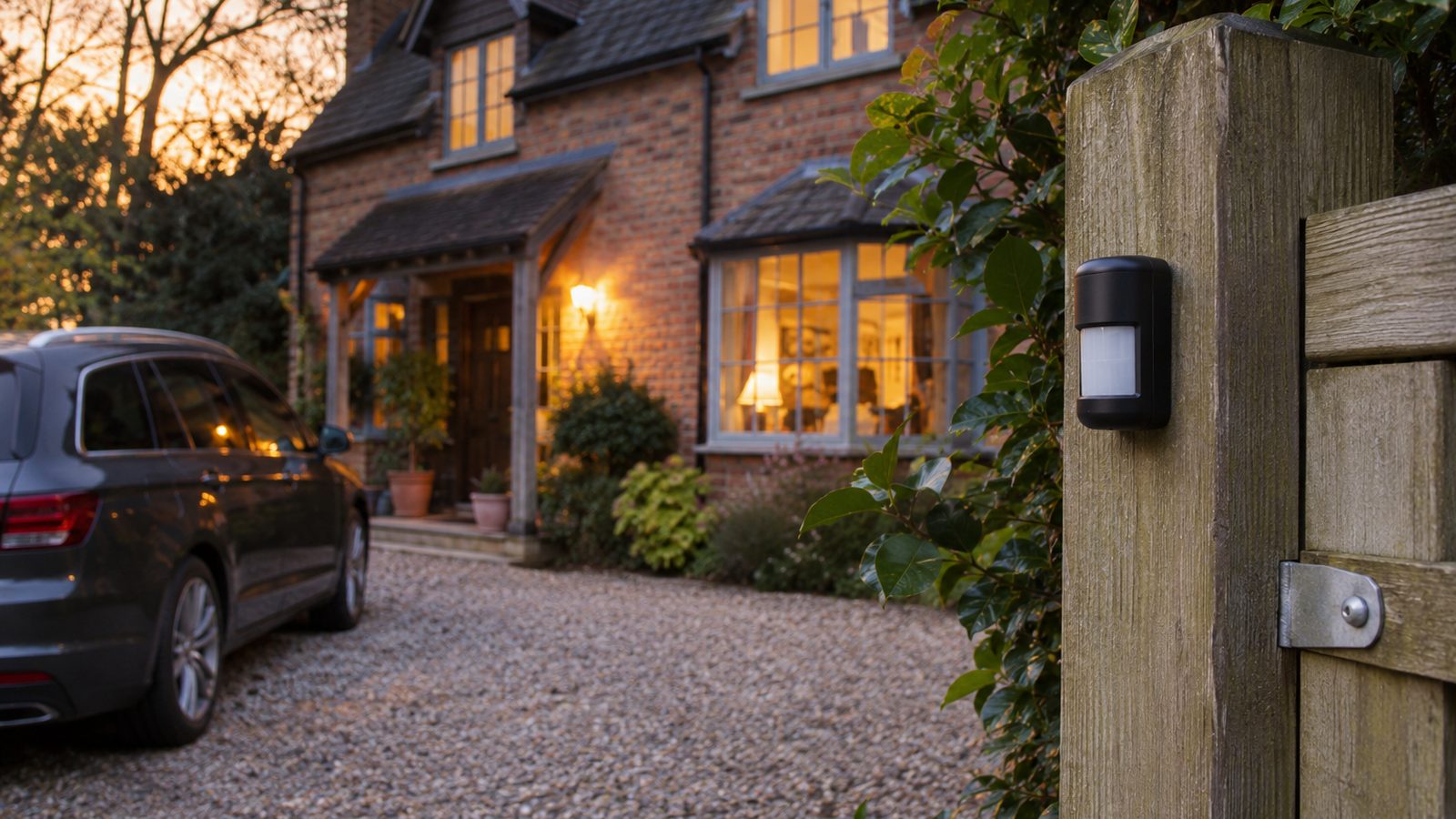
AI-generated illustration
A camera tells you what happened. A driveway alarm tells you it is happening — with a chime inside the house the moment someone or something comes onto your drive. For homes with long drives, rural properties, or anyone worried about keyless car theft, it is one of the cheapest bits of security you can buy.
This is a researched comparison, based on products I have reviewed, manufacturer information and published UK reviews. Some links below are Amazon links. If you buy through them we may earn a small commission at no extra cost to you. As an Amazon Associate I earn from qualifying purchases.
Black Friday 2026: Looking for deals right now? See our Black Friday security camera deals for this year’s best picks.
Quick picks
| Top pick | Best solar | Best for two entrances | Best budget | |
|---|---|---|---|---|
| Product | HTZSAFE 1/2 Mile | BetterLink Solar | 800m Solar 2-sensor kit | 800m Budget kit |
| Power | AA batteries | Solar | Solar | AA batteries |
| Sensors included | 1 (expandable) | 1 (expandable) | 2 | 1 |
| Wi-Fi or subscription | No | No | No | No |
| Buy | Amazon | Amazon | Amazon | Amazon |
How a driveway alarm works
An outdoor PIR motion sensor detects people or vehicles crossing its beam and sends a radio signal to a plug-in receiver inside the house, which sounds a chime. That is it. No Wi-Fi, no app, no subscription, no monthly fee.
Most systems let you add more sensors, each assigned to a different chime tone. That means you can know whether it was the front gate or the side entrance that triggered — useful once you have fitted more than one.
Driveway alarm or camera?
Ideally both. A camera gives you evidence; an alarm gives you early warning. The practical combination: the chime wakes you up or puts you on alert, then you open the camera’s live view to see what is happening. For outdoor camera options, see the best outdoor security cameras.
Who should get one
- Long or hidden drives, where you cannot hear footsteps from the house
- Rural homes, where the next house is far away and an approach can go unnoticed
- Anyone worried about keyless car theft — the chime wakes you before the theft is complete. See how to stop keyless car theft
- Dark autumn and winter nights, when opportunist crime rises. See the dark nights home security checklist
- Carers and family members wanting to know when an elderly relative arrives home or leaves
Reviews
HTZSAFE 1/2 Mile Driveway Alarm — top pick
The HTZSAFE is the best-known driveway alarm on the UK market, with a very large number of reviews. The owl-shaped sensor is weatherproof and runs on AA batteries. The half-mile quoted range is in open ground — in practice, across a drive with the signal going through a house wall, most buyers report it working reliably at the distances a home driveway requires.
The system is expandable: buy additional sensors and assign each one a different chime, so you know which entrance was triggered. That makes it the most versatile starting point for anyone who might want to grow the setup later.
Honest downside: some buyers report water ingress into the sensor housing over time in heavy rain. Mount it angled slightly down and ideally with some overhead cover — under a fence cap or overhang — to help.
HTZSAFE 1/2 Mile Driveway Alarm on Amazon
BetterLink 1/2 Mile Solar Driveway Alarm — best solar
The BetterLink runs on a built-in solar panel, which means no battery swaps once it is fitted. In a typical UK garden that gets reasonable daylight, most buyers find it keeps itself topped up reliably through spring, summer and autumn. Winter performance depends on how much direct sun the mounting spot gets.
It comes with one sensor to start and is expandable if you want to cover a second entrance. Check the current price — solar models tend to cost a little more than battery versions for the convenience.
BetterLink Solar Driveway Alarm on Amazon
800m Solar Driveway Alarm Kit (two sensors) — best for two entrances
This kit comes with two sensors out of the box, which makes it the natural choice if you have a gate and a side entrance, or a front drive and a back garden path. Each sensor can be assigned its own chime tone so you know which was triggered.
Both sensors are solar powered. Like all solar models, they need some daylight to stay charged, so check the mounting spots get enough sun before committing. Check the current price.
800m Solar Driveway Alarm (two sensors) on Amazon
800m Driveway Alarm System — best budget
If you want to try a driveway alarm on one entrance for the least outlay, this is it. It covers the basics — one sensor, one indoor receiver, radio operation with no Wi-Fi or subscription — and the reviews at this price point are solid.
The honest trade-off: the build quality and range will not match the HTZSAFE, and the single sensor limits you to one entrance. But as a first alarm on a tight budget it does the job. Check the current price.
800m Driveway Alarm System on Amazon
How to set it up without false alarms
Getting the placement right makes the difference between a useful alarm and one that chimes every time a car passes on the road.
- Height: about 1 metre works well for both people and vehicles. Too low and it picks up small animals reliably; too high and it misses low vehicles.
- Point across the drive, not down it. A PIR sensor detects movement across its field of view far better than something approaching directly towards it. Mount it on a gatepost or fence so the sensor faces across the entrance.
- Angle it away from the road and neighbours’ paths. If the road or a neighbour’s drive is within the sensor’s field of view, you will get false alerts every time traffic or a neighbour passes.
- Clear of moving hedges and shrubs. Branches swaying in the wind are a very common cause of false triggers. Make sure nothing moves in front of the sensor.
- Not facing the rising or setting sun. Strong direct sunlight into the PIR lens can cause false triggers.
- If cats or foxes are a problem: lower the sensitivity setting (most sensors have a dial), raise the mounting height slightly, and angle it down more so it detects larger shapes crossing.
- Test it. Walk past it and drive past it. Then go indoors and check the chime reaches every room you use — especially upstairs bedrooms at night.
Real-world range
The half-mile and 800m figures on the packaging are measured across open, flat ground with no obstructions. A typical installation — signal passing through a fence, across a drive, and then through a house wall — will cut the effective range considerably. For most home drives this is not a problem; the distance is short. But if you are installing in a barn, outbuilding or at the bottom of a long rural drive, test the signal before fixing the sensor permanently.
Battery or solar
Battery models are cheaper and work anywhere regardless of sun exposure. On a busy drive that triggers dozens of times a day, batteries will need replacing every few months. On a quieter drive or outbuilding they can last much longer.
Solar models need no battery changes once fitted, but UK winters are short on sun and a poorly placed panel can struggle from November to February. If you go solar, choose a mounting spot that gets direct sun for most of the day and keep the panel clean.
My verdict
For most homes I would start with the HTZSAFE owl kit. The range is good, the build is solid for the price, and the expandable system means you can add sensors as needed rather than buying a kit with sensors you do not use yet. If changing batteries ever becomes an annoyance, the BetterLink solar is the natural upgrade.
Whatever you choose, pair it with a camera on the drive. The alarm wakes you up; the camera shows you who it was. See the best outdoor security cameras.
Common questions
Do driveway alarms work?
Do driveway alarms need Wi-Fi?
Will animals set off a driveway alarm?
How far do driveway alarms work?
Related guides

How to stop keyless car theft from your driveway
How thieves steal keyless cars from UK driveways and the steps that stop them: signal-blocking pouches, steering locks, OBD locks and CCTV.

Dark nights home security checklist
The clocks have gone back. A practical checklist to make your home look occupied, light up dark spots and keep cameras working all winter.

Best outdoor security cameras UK
The best outdoor security cameras for UK homes — wired, solar and battery picks from a security professional, with no monthly subscription.