Window security cameras: do they actually work at night?

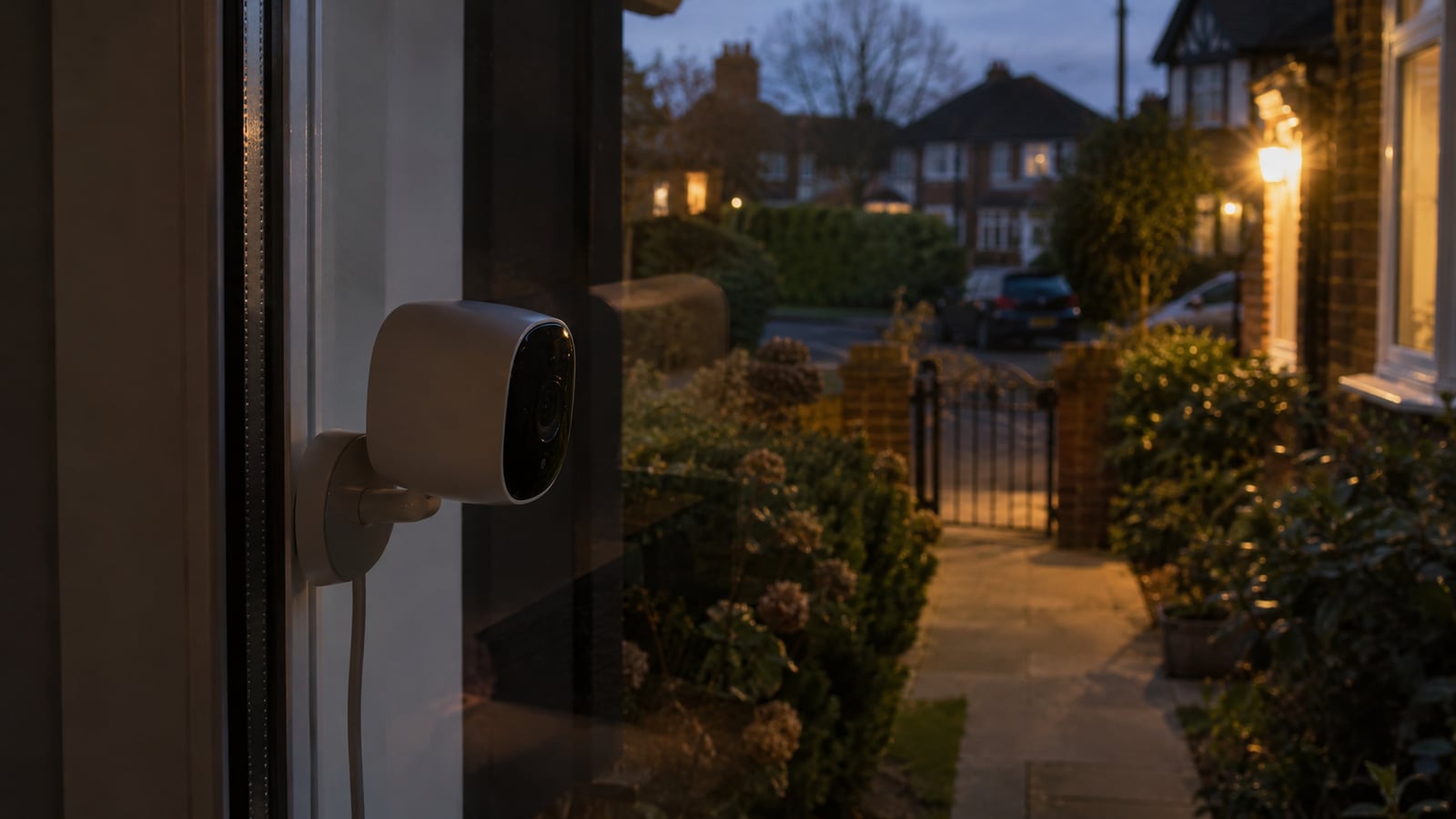
AI-generated illustration
You see it all the time. Someone buys an indoor camera, puts it on the windowsill pointing out at the drive, and it looks brilliant during the day. Then night falls, and all you can see is a white glare or the camera’s own lights reflected back. In my work I come across this constantly.
Window cameras are now one of the fastest-growing types of camera on Amazon, aimed at people who cannot drill or fix anything outside. This guide explains what goes wrong, what window cameras do differently, and how to get a picture you can actually use.
Some links below are Amazon links. If you buy through them we may earn a small commission at no extra cost to you. As an Amazon Associate I earn from qualifying purchases.
We are testing a window camera at home right now. This guide will be updated with our own photos and day and night results.
Why a normal camera fails at night
When it gets dark, most cameras switch to infrared (IR) night vision. Small IR lights around the lens light up the scene, invisibly to us.
Point that camera through glass and the IR light hits the window and bounces straight back into the lens. The camera is blinded by its own light. You get:
- a white haze across the whole picture
- the glowing dots of the IR lights reflected back
- a reflection of your room instead of the garden
During the day there are no IR lights, so the picture is fine. That is why so many people think it works, until the first time they need night footage.
How window cameras are different
Cameras sold as “window cameras” try to solve this in three ways:
- No infrared lights. Instead they use a sensitive colour sensor that works in low light.
- A mount that sits flat on the glass, often a magnetic sticker, so there is no gap for light to bounce around.
- A shaped surround around the lens to block reflections from inside the room.
The catch: without IR, they cannot see in complete darkness. The makers say so themselves. They need some light outside: a street light, a porch light or a security light.
Who they suit
- Renters, who cannot drill or fix things to the outside of the building
- Flats, where you only own the inside
- Leasehold or listed properties, where outside fixings need permission
- Anyone wanting a quick, temporary camera, for example while away at Christmas
The window cameras selling now
These are the window cameras appearing in Amazon’s best sellers. They come from smaller brands than eufy or Tapo, so check the reviews of the app as well as the camera.
Wansview K1. The best-selling window camera, with thousands of reviews. Dual-band Wi-Fi, colour night vision without IR, and a magnetic window mount. This is the one we are testing. Wansview K1 on Amazon
Outinput 3MP 2K window camera. Sold as no monthly fee, sticks to the window, colour night vision. Outinput window camera on Amazon
Other window cameras. Search for “window security camera anti glare” to compare other brands.
Already have a normal camera at the window? Try this
- Turn the infrared off in the camera’s app. Look for “night vision”, “IR” or “infrared” and set it to off.
- Light the outside. A motion sensor security light or porch light gives the camera something to see by. See the best security lights.
- Press the lens right up to the glass. The smaller the gap, the less glare.
- Block the room behind it. A dark card or cloth around the camera, or the curtain closed behind it, stops room reflections.
- Turn off lights in that room at night, or they will reflect in the glass.
If none of that works, the honest answer is a proper outdoor camera. See the best outdoor security cameras.
Other things that affect the picture
- Double glazing has two panes, so two chances for reflection. Get the lens as close as you can.
- Tinted or coated glass can darken the picture or change its colour.
- Condensation on cold mornings can fog the view.
- Dirty glass shows up badly at night. Clean both sides.
- The camera can only see what the window sees. Check the view covers your door, drive or path before buying.
Window camera or outdoor camera?
| Window camera | Outdoor camera | |
|---|---|---|
| Drilling | None | Usually |
| Night picture | Needs outside light | Infrared works in darkness |
| Weather | Protected indoors | Must be weatherproof |
| Theft | Hard to reach | Can be stolen if low |
| Best for | Renters, flats, quick setups | Most homeowners |
My view: if you own your home and can fit an outdoor camera, do that. It sees in the dark. If you rent or cannot drill, a window camera plus a security light outside is a genuinely good setup.
Looking for cameras to use inside the house? See best indoor security cameras.
More help: home CCTV setup mistakes and where CCTV cameras should go.
Common questions
Can I put a security camera behind a window?
Why is my camera white at night through the window?
Do window cameras work in complete darkness?
Are window cameras good for renters?
Is it legal to record the street through my window?
Related guides

The best indoor security cameras in the UK
The best indoor cameras for keeping an eye on your home, pets or a relative, compared on storage, monthly fees and privacy, with plain-English advice on where to put them.

Best security lights UK: solar and motion sensor
The best outdoor security lights for UK homes: solar, PIR floodlights and camera floodlights. How bright, where to fit them, and neighbour rules.

Best outdoor security cameras UK
The best outdoor security cameras for UK homes — wired, solar and battery picks from a security professional, with no monthly subscription.

Home CCTV setup mistakes: why your cameras aren't working properly
The most common home camera setup mistakes, from Wi-Fi and 4G signal to battery drain and missed alerts, and how to fix each one.